
In Government Sales, Different is Better than Better
I’ve started and scaled multiple technology companies that broke into the government market through state and local procurement. If there’s one lesson I wish more founders understood earlier, it’s this: product and service positioning matters more in government than almost anywhere else—and being different often matters more than being better.
Ideally, of course, you’re both. But if you have to choose, difference wins.
The positioning trap most companies fall into
Many first-time government sellers lead with incremental superiority: faster, cheaper, more accurate, more configurable. Those claims may be true, but in the public sector they tend to blur together. Procurement officials, agency leaders, and—critically—politicians and legislators sit in back-to-back meetings all day. They don’t have time to parse fine-grained comparisons across ten vendors who all sound “best in class.”
What does stick is a clear, distinct idea.
The 4-quadrant reality of government buying
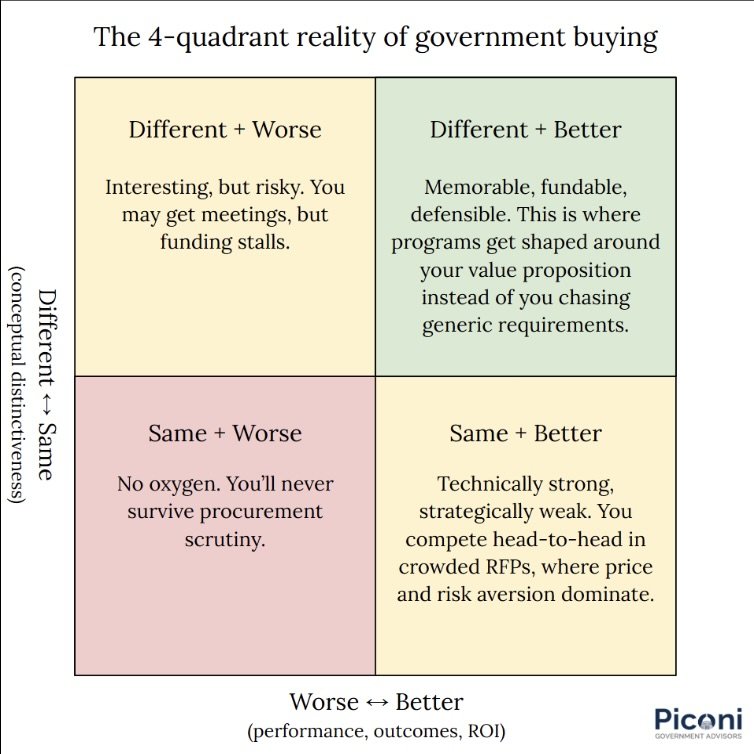
I often explain this to teams using a simple 2-axis framework:
X-axis: Better ↔ Worse (performance, outcomes, ROI)
Y-axis: Different ↔ Same (conceptual distinctiveness)
This gives you four quadrants:
Same + Worse
No oxygen. You’ll never survive procurement scrutiny.Same + Better
Technically strong, strategically weak. You compete head-to-head in crowded RFPs, where price and risk aversion dominate.Different + Worse
Interesting, but risky. You may get meetings, but funding stalls.Different + Better (the goal)
Memorable, fundable, defensible. This is where programs get shaped around your value proposition instead of you chasing generic requirements.
Why “different” unlocks funding faster
Here’s the counterintuitive part: it is often easier to get a truly different idea funded.
When your solution is meaningfully distinct, there’s less noise. Legislators and agency executives can more easily explain why they are funding you versus another vendor. The rationale is cleaner: “This is the only company addressing X in this way.” That clarity matters enormously when public dollars, oversight, and political accountability are involved.
In contrast, funding a “better version” of something that already exists invites comparison, debate, and delay. The more vendors look alike, the harder it is for decision-makers to justify choosing just one.
Differentiation must be intentional and communicable
Being different isn’t accidental—and it isn’t just a feature list. It’s how you frame the problem, define the outcome, and position your role in the ecosystem. Founders must clearly identify, articulate, and relentlessly communicate their differentiators in language that non-technical stakeholders can repeat.
If a legislator can’t summarize what makes you unique after a 20-minute briefing, you don’t have a positioning strategy—you have a product description.
Government markets reward companies that are distinct, defensible, and demonstrably better. Get your positioning right, and procurement becomes a growth lever instead of a barrier.
Thanks for reading.
LP